
Enterprise companies increasingly rely on staffing vendors, recruitment process outsourcers (RPOs), and managed service providers (MSPs) to execute their talent acquisition functions. Many of these vendors now deploy artificial intelligence tools to screen, score, and rank candidates at scale. What few enterprise legal and HR teams fully appreciate is this: outsourcing the hiring function does not outsource the legal liability.
Under federal and state employment discrimination law, enterprises remain exposed to disparate impact and other claims arising from their vendors' AI practices, regardless of whether the enterprise selected the technology, knew how it worked, or had any direct role in its deployment. As state regulators move from guidance to enforcement and private litigants find new theories of recovery, the absence of contractual AI governance controls has become the single most significant unaddressed compliance gap in enterprise talent operations.
The Foundational Principle: Disparate Impact Does Not Require Intent
Title VII of the Civil Rights Act prohibits not only intentional discrimination but also neutral employment practices that produce a disparate impact on protected classes — that is, practices that disproportionately exclude applicants on the basis of race, sex, national origin, religion, or color without sufficient business justification. Griggs v. Duke Power Co., 401 U.S. 424 (1971). The statute does not ask whether the employer meant to discriminate. It asks whether the outcome discriminated.
This principle has direct and underappreciated application to algorithmic hiring tools. An AI screening model trained on historical hiring data reflecting prior workforce demographics may systematically deprioritize candidates from protected classes. A resume-parsing algorithm that penalizes gaps in employment history may disproportionately screen out women who took parental leave. A voice-analysis tool that scores communication style may encode cultural and national origin bias. The mechanism is invisible to the end user, but the disparate outcome is a statutory violation regardless of the mechanism's opacity.
Title VII's disparate impact framework applies fully to AI-assisted hiring tools. Employers may not avoid liability by attributing discriminatory outcomes to a vendor's proprietary technology. The agency is not interested in who built the algorithm. It is interested in who made the hire.
EEOC Technical Assistance: Artificial Intelligence and Algorithmic Fairness Initiative (May 2023)
Indirect Employment Relationships Provide No Liability Shield
Enterprise counsel frequently assume that the staffing vendor relationship creates a clean liability partition: the vendor employs the workers, deploys the tools, and makes the screening decisions, while the enterprise client is merely the recipient of a delivered workforce. Litigation and regulatory enforcement have repeatedly demonstrated that this assumption is legally unfounded.
The joint employer doctrine, applied under Title VII, the ADEA, the ADA, and equivalent state statutes, examines the economic and functional reality of the employment relationship rather than its contractual form. Courts evaluate factors including the degree of control exercised over hiring decisions, whether the enterprise sets qualification criteria, and the degree to which the enterprise's operational requirements shape the candidate pool. Zheng v. Liberty Apparel Co., 355 F.3d 61 (2d Cir. 2003); Bristol v. Board of County Commissioners, 312 F.3d 1213 (10th Cir. 2002).
In the staffing vendor context, enterprise clients routinely provide job specifications, minimum qualification thresholds, and volume-per-period requirements that directly shape how vendor AI tools are configured and applied. When the enterprise provides those inputs and then accepts the resulting candidate slates without scrutiny, it has functionally participated in a hiring practice that may be discriminatory. The contractual label (“vendor” rather than “employer”) does not change the legal analysis.
When a temporary employment agency and its client joint employer violate Title VII, the client may be jointly and severally liable for the full amount of the relief awarded.
EEOC Enforcement Guidance on Contingent Workers (1997)
The Regulatory Landscape Is No Longer Theoretical
For much of the past decade, AI employment discrimination risk existed primarily as a litigation exposure with limited regulatory scaffolding. That has changed materially, and the pace of change is accelerating.
New York City Local Law 144 (effective July 5, 2023)
Requires employers and employment agencies to conduct and publish independent bias audits before deploying automated employment decision tools (AEDTs) in hiring or promotion decisions affecting New York City residents. The law does not exempt enterprise users who receive AI-screened candidate slates from third-party vendors; courts and regulators will interpret it to include downstream recipients of AI-generated candidate rankings.
Illinois Human Rights Act Amendment (HB 3773, effective January 1, 2026)
Requires employers to address AI use across recruitment, hiring, promotion, and related decisions. Imposes a disparate-effect monitoring duty. The Illinois Department of Human Rights is actively enforcing these provisions.
Colorado AI Act (SB 24-205, effective June 30, 2026)
Requires employers to exercise reasonable care to protect employees and job applicants from algorithmic discrimination in consequential decisions, including hiring. Enterprises using vendor AI in Colorado hiring pipelines must demonstrate affirmative due diligence. Penalties of up to $20,000 per violation.
Connecticut AI Responsibility and Transparency Act (SB 5)
AEDT provisions effective October 1, 2026; governance program obligations effective October 1, 2027. Codifies that automated decision-making is not a defense to a discrimination claim. The implementation window is not a reason for inaction; it is the procurement cycle timeline.
New Jersey DCR Regulations (NJAC 13:13, effective December 15, 2025)
Impose disparate-impact liability for AI hiring tools under the New Jersey Law Against Discrimination. New Jersey has some of the broadest anti-discrimination protections in the country, and these regulations extend full liability for vendor AI outcomes to end-user enterprises operating in the state.
The trajectory is clear: what began as voluntary guidance has become mandatory audit requirements, and mandatory audit requirements will become enforced liability. Enterprises that are not building compliance infrastructure today are accumulating regulatory debt at an accelerating rate.
What Courts Are Examining: The Litigation Roadmap
Three matters in recent years provide a detailed picture of how courts and plaintiffs are constructing AI discrimination claims, and what evidentiary questions will define liability.
Mobley v. Workday, Inc. (N.D. Cal., filed 2023)
Plaintiff Derek Mobley alleged that Workday's applicant tracking and screening AI systematically rejected his applications on the basis of race, age, and disability. The district court's March 2024 decision allowing the disparate impact claims to proceed confirmed that AI hiring tool vendors bear independent liability, but the reasoning also implies significant exposure for employer-clients who accepted AI-generated outcomes without validation. The court's analysis examined whether Workday's clients knew AI tools were being used, whether they validated accuracy and fairness, and whether any human review existed.
ACLU v. Clearview AI and Related Litigation
Courts have focused on the notice problem: whether candidates in AI-assisted hiring processes had meaningful opportunity to understand that automated systems were making decisions affecting them. This has direct parallels to the FCRA's adverse action notice requirements, the legal theory pursued in the Eightfold AI class action litigation, where plaintiffs alleged that AI-generated candidate scores functioned as consumer reports under the Fair Credit Reporting Act, triggering disclosure and adverse action notice obligations that the enterprise and its vendor failed to provide.
The Four Questions Courts Are Asking: (1) Did the enterprise know AI tools were being used? (2) Did it take steps to validate accuracy and fairness? (3) Did human oversight exist at any point in the screening process? (4) Were candidates notified? Enterprises that cannot provide documented, affirmative answers to all four questions face a litigation posture that is effectively indefensible.
The Contract Gap: Where the Real Exposure Lives
The most significant and most addressable AI compliance gap in enterprise talent operations is not the AI itself. It is the absence of contractual controls governing how vendors deploy AI in work performed on the enterprise's behalf.
A review of standard staffing vendor master service agreements reveals that the overwhelming majority contain no AI disclosure requirement, no audit right, no technology change notification obligation, and no human oversight mandate. Enterprises are, in effect, contracting for a hiring outcome while knowingly remaining ignorant of the process by which that outcome is produced. Under disparate impact doctrine, and increasingly under state-specific AI governance requirements, that ignorance is not a defense. It is evidence of insufficient due diligence.
Background check governance achieved standardization because the legal liability was clear, the compliance cost of ignorance was high, and the market developed around documented, enforceable standards. AI governance is in the same position today that background check governance was fifteen years ago.
What Defensible Practice Requires
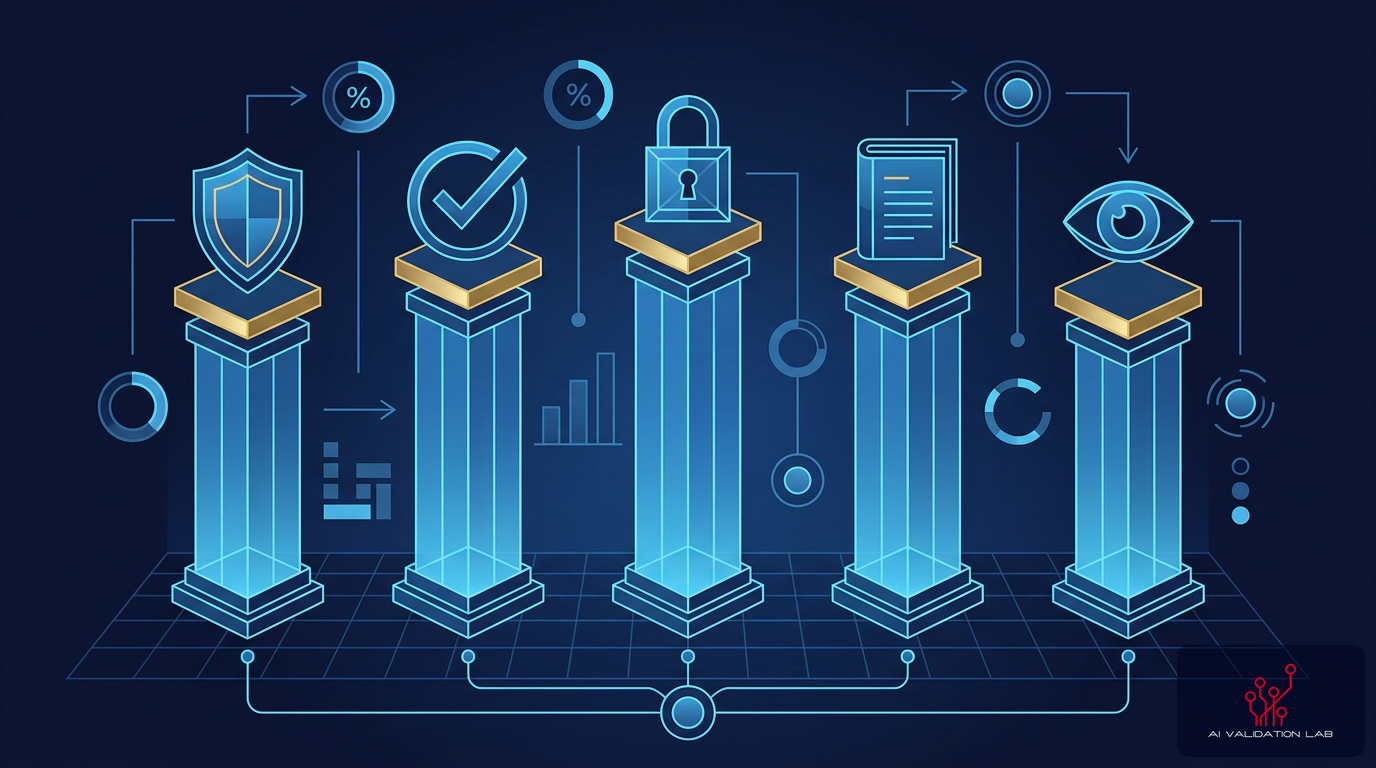
Emerging regulatory guidance and litigation trends establish a relatively clear picture of what defensible AI governance in vendor-managed hiring looks like. It does not require perfection. It requires documented, reasonable, affirmative effort. The elements are these:
1. AI Disclosure Requirements in Vendor Contracts
Vendors should be required to disclose all AI or automated tools used in candidate screening, scoring, or ranking, including tools embedded in applicant tracking systems or sourcing platforms. Disclosure should include the vendor or developer of the tool, the protected characteristics it is designed not to consider, and the most recent bias audit results.
2. Independent Third-Party Assessment of Vendor AI Systems
Self-certification by AI vendors is insufficient. Defensible practice requires that bias audits be conducted by qualified, independent assessors: not the vendor's internal team, not the vendor's customer. The New York City Local Law 144 model, requiring publication of independent audit results, provides a useful floor. Enterprises should require equivalent documentation.
3. Contractual Audit Rights
Master service agreements should include the right to audit vendor AI systems, either directly or through designated third-party assessors, with a specified audit frequency, defined scope, and remediation timeline for identified disparities.
4. Technology Change Notification Requirements
AI systems are not static. Model updates, training data changes, and feature modifications can alter a tool's performance characteristics and disparate impact profile. Vendor contracts should require notification of material changes with sufficient lead time for enterprise review.
5. Human Oversight Mandates
No AI screening decision should be fully automated in a manner that forecloses human review. Contracts should specify at what points in the screening process human judgment is applied, and should require that final selection decisions involve human review rather than purely algorithmic output.
6. Candidate Notification Practices
Given the FCRA litigation risk and the state notice requirements, enterprise clients should require their vendors to implement candidate notification practices as a contractual obligation, ensuring that applicants are informed when AI is being used to assess them and that adverse action notification procedures are triggered appropriately.
The goal of these measures is not to eliminate AI risk; it is to generate the documented record of reasonable care that courts and regulators look for when assessing liability. The enterprise that can demonstrate it asked the right questions, required the right disclosures, and exercised ongoing oversight is in a categorically different legal position than the enterprise that simply accepted what the vendor provided.
The Standardization Imperative
Enterprise risk tolerance should not be the measure of compliance adequacy. A patchwork approach, where some enterprises impose governance requirements and others do not, creates inconsistency across the vendor marketplace that benefits no one. It is impossible to defend in litigation and actively frustrates the market's ability to develop a clear compliance standard.
The lesson of background check standardization, FCRA compliance, and SOC 2 certification for data security is consistent: when legal liability is clear, the market coalesces around documented, auditable, independently verifiable standards. Enterprises that wait for that standard to be imposed by regulation or litigation before building governance infrastructure are not managing risk. They are deferring it.
As regulatory frameworks mature and private litigation refines the theories of enterprise exposure for vendor AI practices, independent third-party governance frameworks are emerging as the recognized standard of care: the documented, auditable, objectively defensible posture that distinguishes enterprises that took the risk seriously from those that did not. Employment counsel advising enterprise clients on talent operations contracts should treat AI governance with the same structural seriousness as FCRA compliance, background check standardization, and data privacy, because the liability exposure, and the regulatory trajectory, are equally serious.
This article is intended for informational purposes and does not constitute legal advice. Employers with questions about AI governance in talent acquisition should consult experienced employment counsel.