United States — Federal
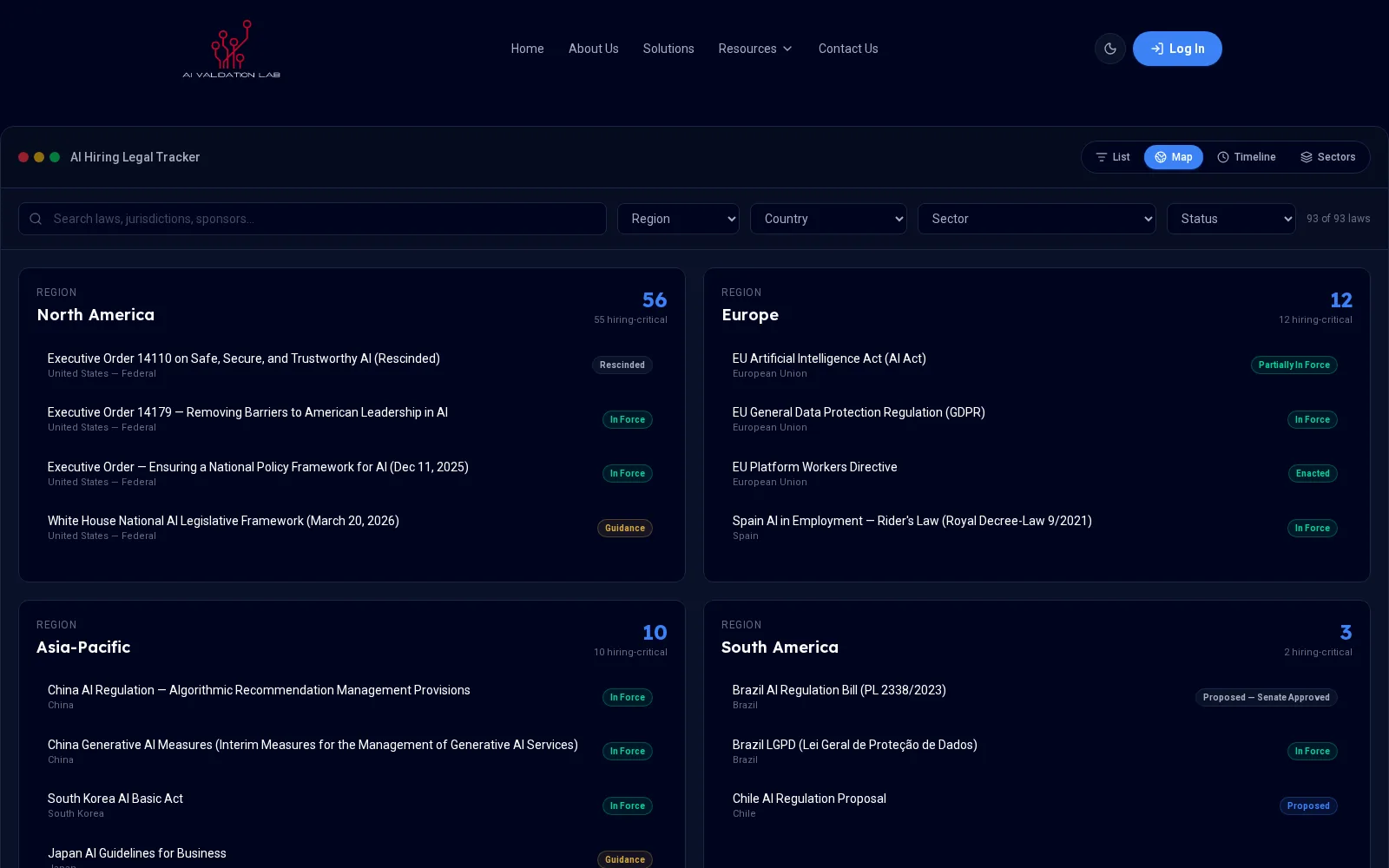
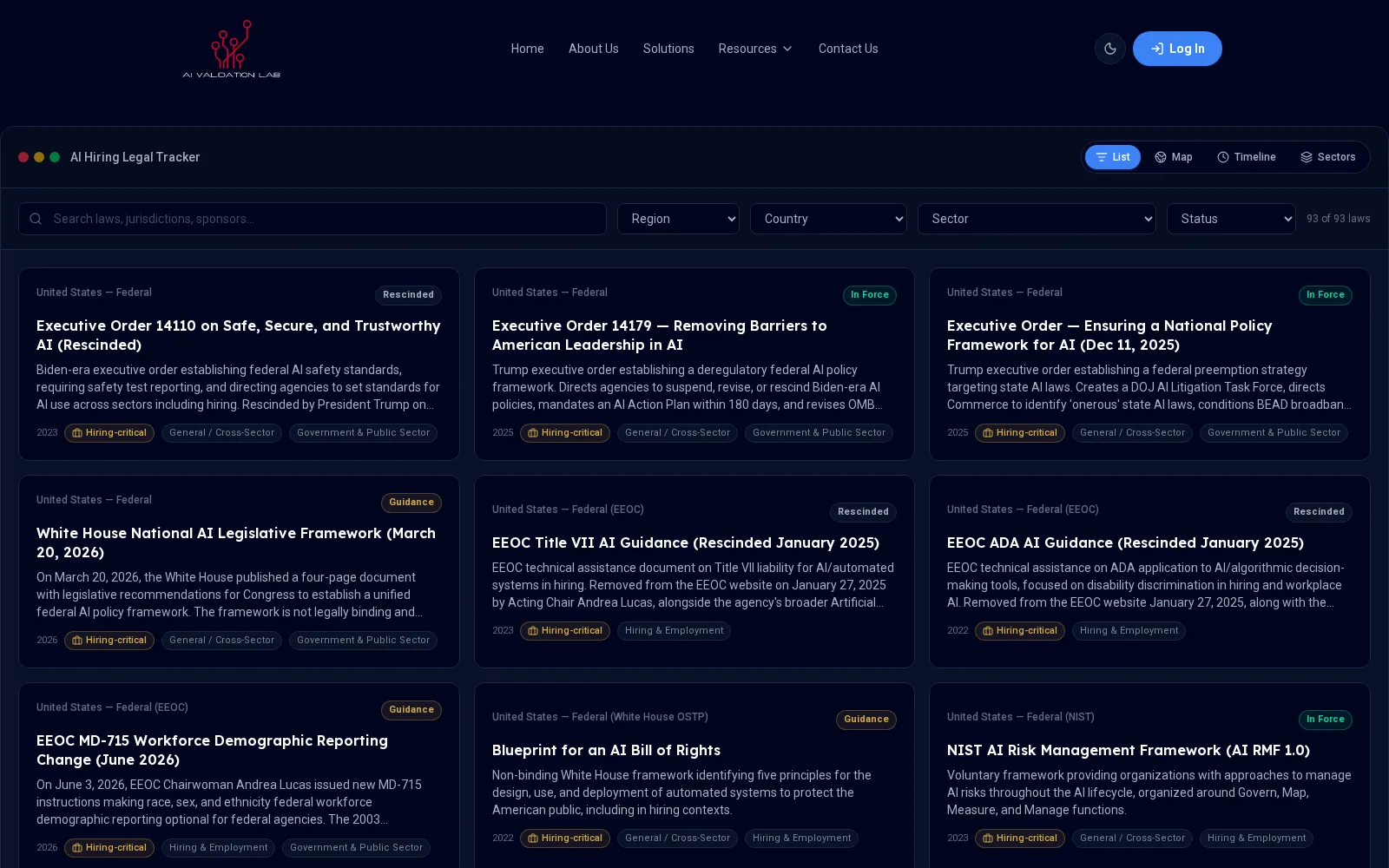
In Force Executive Order 14110 on Safe, Secure, and Trustworthy AI Comprehensive executive order establishing federal AI safety standards, requiring developers of powerful AI systems to share safety test results with the government, and directing agencies to set standards for AI use across sectors including hiring.
2023 Hiring-criticalGeneral / Cross-Sector Government & Public Sector United States — Federal (EEOC)
In Force EEOC Guidance on AI and Automated Systems in Employment EEOC technical assistance document clarifying that Title VII of the Civil Rights Act applies to employer use of AI and automated systems in hiring, explaining how disparate impact liability applies to algorithmic decision-making.
2023 Hiring-criticalHiring & Employment United States — Federal (EEOC)
In Force EEOC Guidance on AI and the Americans with Disabilities Act EEOC guidance on how the ADA applies to employers' use of AI and algorithmic decision-making tools, with focus on disability discrimination risks in hiring and workplace AI.
2022 Hiring-criticalHiring & Employment United States — Federal (White House OSTP)
Guidance Blueprint for an AI Bill of Rights Non-binding White House framework identifying five principles for the design, use, and deployment of automated systems to protect the American public, including in hiring contexts.
2022 Hiring-criticalGeneral / Cross-Sector Hiring & Employment United States — Federal (NIST)
In Force NIST AI Risk Management Framework (AI RMF 1.0) Voluntary framework providing organizations with approaches to manage AI risks throughout the AI lifecycle, organized around Govern, Map, Measure, and Manage functions.
2023 Hiring-criticalGeneral / Cross-Sector Hiring & Employment United States — Federal
Proposed No Robot Bosses Act Federal bill that would require employers to disclose use of automated decision systems in employment, mandate human oversight, allow worker opt-out, and prohibit exclusive reliance on AI for consequential employment decisions.
2024 Hiring-criticalHiring & Employment United States — Federal
Proposed AI LEAD Act (AI Labeling and Evaluation for Applicant Determination) Proposed federal legislation requiring employers to notify job applicants when AI is used in hiring decisions and to conduct bias audits of AI hiring tools.
2024 Hiring-criticalHiring & Employment United States — Federal
Proposed Algorithmic Accountability Act Proposed legislation requiring companies to conduct impact assessments on automated decision systems, including hiring algorithms, and report findings to the FTC.
2023 Hiring-criticalGeneral / Cross-Sector Hiring & Employment United States — Federal
Proposed American Privacy Rights Act (APRA) Comprehensive federal privacy bill that includes provisions requiring impact assessments for algorithms used in consequential decisions, including employment.
2024 Hiring-criticalGeneral / Cross-Sector Consumer Protection United States — Federal (DOL)
In Force DOL Guidance on AI and Worker Well-Being Department of Labor principles and best practices for developers and employers regarding AI's impact on workers, covering hiring, monitoring, compensation, and workplace safety.
2024 Hiring-criticalHiring & Employment New York City, NY
In Force NYC Local Law 144 (Automated Employment Decision Tools) First-in-nation law requiring employers and employment agencies in NYC to conduct annual independent bias audits of AI hiring tools and provide notice to candidates when such tools are used.
2023 Hiring-criticalHiring & Employment Illinois Artificial Intelligence Video Interview Act First state law addressing AI in hiring. Requires employers using AI to analyze video interviews to notify applicants, explain how the AI works, and obtain consent. Also requires destruction of video upon request.
2020 Hiring-criticalHiring & Employment Illinois AI and Employment Law Amendment (HB 3773) Amends the Illinois Human Rights Act to prohibit employers from using AI in ways that produce discriminatory effects in employment decisions. Establishes employer liability for AI-driven disparate impact.
2026 Hiring-criticalHiring & Employment Maryland Facial Recognition in Hiring Law (HB 1202) Prohibits employers from using facial recognition technology during job interviews unless the applicant signs a waiver expressly consenting to its use.
2020 Hiring-criticalHiring & Employment Colorado AI Act (SB 24-205) Comprehensive state AI law requiring developers and deployers of high-risk AI systems to conduct impact assessments, implement risk management policies, provide transparency, and avoid algorithmic discrimination. Hiring is listed as a high-risk domain.
2026 Hiring-criticalGeneral / Cross-Sector Hiring & Employment Texas Responsible AI Governance Act (TRAIGA, HB 1709) Proposed comprehensive AI law establishing high-risk AI classification, impact assessment requirements, and transparency obligations similar to the Colorado AI Act and EU AI Act.
2025 Hiring-criticalGeneral / Cross-Sector Hiring & Employment California AI Transparency Act (AB 2013) Requires developers of generative AI systems to post clear documentation on their websites about training data, including summaries of datasets used, data collection sources, and known limitations.
2026 Hiring-criticalGeneral / Cross-Sector Consumer Protection California Automated Decision Tools (AB 2930) Would require deployers of automated decision tools used in consequential decisions (including employment) to conduct impact assessments and provide notices to affected individuals.
2024 Hiring-criticalGeneral / Cross-Sector Hiring & Employment New Jersey AI Hiring Law (S 1588 / A 3854) Proposed legislation requiring employers using AI in hiring to conduct bias audits, provide candidate notice, and register automated decision tools with the state. Among the most detailed state proposals for AI hiring regulation.
2025 Hiring-criticalHiring & Employment New York State AI Hiring Regulation (S 7623) Proposed statewide expansion of NYC Local Law 144 principles, requiring bias audits and candidate notice for automated employment decision tools used anywhere in New York State.
2024 Hiring-criticalHiring & Employment Connecticut AI in Employment Act (SB 1103) Proposed legislation requiring employers using AI for employment decisions to conduct impact assessments, provide notice, and enable human override.
2025 Hiring-criticalHiring & Employment General / Cross-Sector Virginia High-Risk AI Developer and Deployer Act (HB 2094) Proposed comprehensive AI law modeled on the Colorado AI Act, requiring impact assessments for high-risk AI systems including those used in employment decisions.
2025 Hiring-criticalGeneral / Cross-Sector Hiring & Employment Massachusetts AI Bill (HD 1709) Proposed regulation of automated decision-making systems in high-stakes domains including employment, requiring transparency, impact assessments, and anti-discrimination measures.
2025 Hiring-criticalHiring & Employment General / Cross-Sector Washington People's Privacy Act (SB 5838) Comprehensive privacy bill including provisions for algorithmic impact assessments in high-risk domains including hiring and employment.
2024 Hiring-criticalGeneral / Cross-Sector Hiring & Employment Oregon AI Discrimination Prevention Act Would prohibit AI-driven employment discrimination and require employers to test AI hiring tools for bias before deployment.
2025 Hiring-criticalHiring & Employment Minnesota AI in Employment Act Proposed requirements for employers to disclose AI use in hiring, conduct bias assessments, and provide candidates with human review options.
2025 Hiring-criticalHiring & Employment Utah Artificial Intelligence Policy Act (SB 149) Requires disclosure when individuals interact with generative AI. Creates the AI Learning Laboratory under the Utah Office of AI Policy to study AI regulation.
2024 Hiring-criticalGeneral / Cross-Sector Consumer Protection European Union
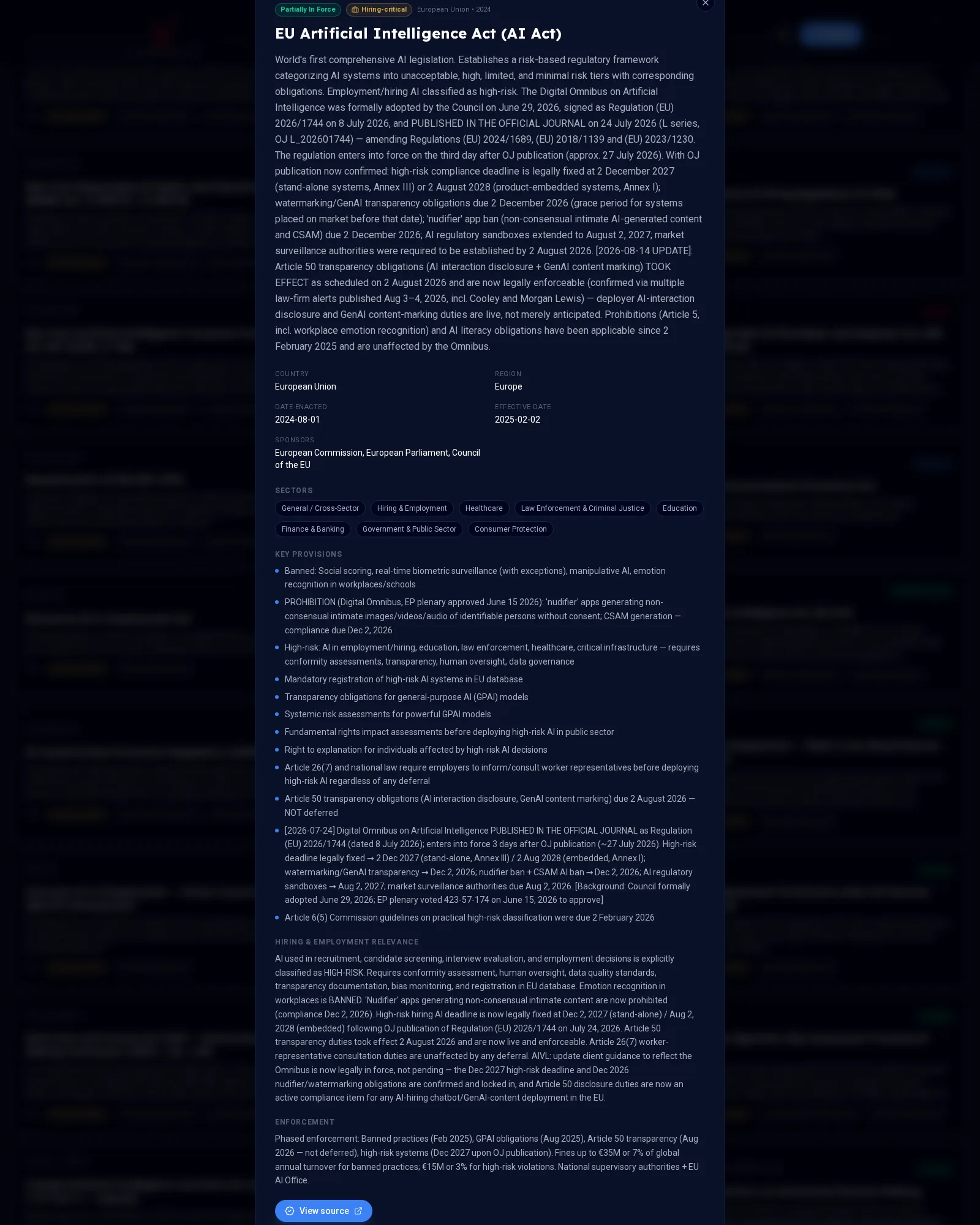
Partially In Force EU Artificial Intelligence Act (AI Act) World's first comprehensive AI legislation. Establishes a risk-based regulatory framework categorizing AI systems into unacceptable, high, limited, and minimal risk tiers with corresponding obligations. Employment/hiring AI classified as high-risk.
2024 Hiring-criticalGeneral / Cross-Sector Hiring & Employment EU General Data Protection Regulation (GDPR) Comprehensive data protection regulation with significant AI implications. Article 22 provides the right not to be subject to solely automated decision-making with legal effects, including employment decisions.
2018 Hiring-criticalGeneral / Cross-Sector Hiring & Employment EU Platform Workers Directive Regulates algorithmic management of platform workers (gig economy). Requires transparency in automated decision-making, human oversight, and prohibits certain AI-driven management practices.
2024 Hiring-criticalHiring & Employment Spain AI in Employment — Rider's Law (Royal Decree-Law 9/2021) Requires companies to inform workers' legal representatives about the parameters, rules, and instructions underlying AI algorithms and automated systems that affect working conditions, hiring, or job assignment.
2021 Hiring-criticalHiring & Employment Germany AI in Employment — Works Council Rights (BetrVG Amendment) Amendments to the Works Constitution Act strengthening works council co-determination rights over employer use of AI in the workplace, including hiring tools.
2021 Hiring-criticalHiring & Employment France AI Employment Provisions (Labor Code & CNIL Guidance) CNIL guidance and labor code provisions requiring transparency and impact assessments for AI systems used in employment, including algorithmic management and AI hiring tools.
2023 Hiring-criticalHiring & Employment General / Cross-Sector Italy AI Employment Protections (Jobs Act Decreto Trasparenza) Italian implementation of EU Transparency Directive, requiring employers to inform workers about automated decision-making and monitoring systems in the workplace.
2022 Hiring-criticalHiring & Employment UK Hiring Algorithm Guidance (EHRC & ICO Joint Statement) Joint guidance from the Equality and Human Rights Commission and Information Commissioner's Office on the lawful and fair use of AI in hiring, covering discrimination, data protection, and transparency.
2023 Hiring-criticalHiring & Employment UK Data Protection and Digital Information Act Post-Brexit reform of UK data protection law, modifying GDPR provisions including automated decision-making rules. Adjusts Article 22 equivalent with more permissive framework for automated decisions but maintains safeguards.
2024 Hiring-criticalGeneral / Cross-Sector Hiring & Employment UK AI Regulation White Paper — Pro-Innovation Approach UK government framework establishing five cross-sectoral AI principles — safety, transparency, fairness, accountability, contestability — to be applied by existing regulators rather than new legislation.
2023 Hiring-criticalGeneral / Cross-Sector Hiring & Employment Netherlands Algorithm Risk Assessment Framework (IAMA) Government-mandated impact assessment framework for algorithmic systems used by public authorities, including employment services and benefit allocation systems.
2022 Hiring-criticalGovernment & Public Sector Hiring & Employment Canada Artificial Intelligence and Data Act (AIDA, Bill C-27 Part 3) Part 3 of Canada's Digital Charter Implementation Act. Would create a framework for regulating high-impact AI systems including those used in employment, requiring impact assessments, transparency, and bias mitigation.
2022 Hiring-criticalGeneral / Cross-Sector Hiring & Employment Quebec Law 25 (Act Respecting the Protection of Personal Information in the Private Sector) Quebec's modernized privacy law with automated decision-making provisions. Requires organizations to inform individuals of automated decisions and provide mechanisms for review.
2023 Hiring-criticalGeneral / Cross-Sector Hiring & Employment Canada — Federal (Public Sector)
In Force Canada Directive on Automated Decision-Making Federal government directive requiring all departments to conduct algorithmic impact assessments before deploying automated systems for administrative decisions, including government hiring.
2020 Hiring-criticalGovernment & Public Sector Hiring & Employment China AI Regulation — Algorithmic Recommendation Management Provisions Regulates algorithmic recommendation systems, requiring transparency, user opt-out mechanisms, and prohibition of algorithmic discrimination. Applies to platforms including job recruitment platforms.
2022 Hiring-criticalGeneral / Cross-Sector Consumer Protection China Generative AI Measures (Interim Measures for the Management of Generative AI Services) Regulates generative AI services in China, requiring safety assessments, content labeling, training data compliance, and algorithmic filing with authorities.
2023 Hiring-criticalGeneral / Cross-Sector Consumer Protection South Korea AI Basic Act Comprehensive AI framework law establishing high-risk AI classification, transparency requirements, and AI ethics principles. Hiring is designated as a high-impact domain.
2025 Hiring-criticalGeneral / Cross-Sector Hiring & Employment Japan AI Guidelines for Business Voluntary guidelines established by the Japanese government for businesses developing and using AI, based on the Hiroshima AI Process principles. Covers transparency, safety, and fairness.
2024 Hiring-criticalGeneral / Cross-Sector Hiring & Employment Singapore AI Governance Framework (Model Framework 2.0) Voluntary governance framework providing practical guidance on responsible AI deployment. Emphasizes explainability, transparency, fairness, and human-centricity. Widely adopted by Singapore-based enterprises.
2020 Hiring-criticalGeneral / Cross-Sector Finance & Banking Singapore AI Verify Foundation & Testing Framework Open-source AI governance testing framework allowing companies to demonstrate responsible AI through standardized tests. Includes testing for fairness, explainability, robustness, and transparency.
2023 Hiring-criticalGeneral / Cross-Sector Hiring & Employment Australia Voluntary AI Safety Standard Australia's voluntary AI safety standard establishing 10 guardrails for organizations developing and deploying AI, including requirements for testing, transparency, and accountability.
2024 Hiring-criticalGeneral / Cross-Sector Hiring & Employment Australia Proposed Mandatory AI Guardrails Proposed mandatory regulations for high-risk AI systems based on the voluntary AI Safety Standard, with hiring/employment as a designated high-risk domain.
2025 Hiring-criticalGeneral / Cross-Sector Hiring & Employment India Digital Personal Data Protection Act (DPDPA) India's comprehensive data protection law with implications for AI systems processing personal data, including automated decision-making in employment contexts.
2023 Hiring-criticalGeneral / Cross-Sector Consumer Protection New Zealand Algorithm Charter for Aotearoa New Zealand Government charter committing agencies to responsible algorithm use, including transparency, human oversight, privacy protection, and accountability for algorithmic decisions including hiring.
2020 Hiring-criticalGovernment & Public Sector Hiring & Employment Brazil AI Regulation Bill (PL 2338/2023) Comprehensive AI bill modeled on the EU AI Act, establishing a risk-based framework with hiring classified as high-risk. Would create Brazil's first dedicated AI regulatory authority.
2023 Hiring-criticalGeneral / Cross-Sector Hiring & Employment Brazil LGPD (Lei Geral de Proteção de Dados) Brazil's comprehensive data protection law with provisions on automated decision-making, including the right to review of automated decisions and right to explanation.
2020 Hiring-criticalGeneral / Cross-Sector Consumer Protection Chile AI Regulation Proposal Proposed comprehensive AI regulation establishing risk-based framework with transparency and accountability requirements, modeled after EU approaches.
2024 General / Cross-Sector Hiring & Employment
South Africa AI & Automated Decision-Making (POPIA Context) South Africa's Protection of Personal Information Act (POPIA) includes provisions on automated decision-making, requiring notification and providing the right to challenge decisions made by automated systems.
2021 Hiring-criticalGeneral / Cross-Sector Hiring & Employment Kenya Data Protection Act — Automated Decision-Making Provisions Kenya's Data Protection Act includes provisions on automated individual decision-making, requiring safeguards when decisions with legal or significant effects are made solely through automated means.
2019 Hiring-criticalGeneral / Cross-Sector Hiring & Employment Israel AI Ethics and Regulation Policy Israeli government policy establishing a soft-law approach to AI governance with principles of transparency, fairness, and accountability.
2023 General / Cross-Sector Hiring & Employment
OECD Member States (38 countries)
In Force OECD AI Principles First intergovernmental standard on AI adopted by 46 countries. Establishes five principles and five recommendations for trustworthy AI. Referenced in nearly all subsequent national AI strategies and regulations.
2019 Hiring-criticalGeneral / Cross-Sector Hiring & Employment UNESCO Member States (193 countries)
In Force UNESCO Recommendation on the Ethics of AI First global normative instrument on AI ethics, adopted by all 193 UNESCO member states. Establishes values and principles for AI governance including proportionality, fairness, non-discrimination, and human oversight.
2021 Hiring-criticalGeneral / Cross-Sector Hiring & Employment Council of Europe (46 countries + signatories)
Enacted Council of Europe Framework Convention on AI (Treaty 225) First legally binding international treaty on AI. Establishes obligations for signatory states to ensure AI respects human rights, democracy, and rule of law. Signed by EU, US, UK, and others.
2024 Hiring-criticalGeneral / Cross-Sector Hiring & Employment EU AI Liability Directive (Proposed) Proposed directive establishing liability rules for AI systems, easing burden of proof for individuals harmed by AI. Would complement the AI Act by creating civil liability framework.
2022 Hiring-criticalGeneral / Cross-Sector Consumer Protection EU Product Liability Directive (Revised) — AI Coverage Revised Product Liability Directive explicitly bringing software and AI systems under product liability law for the first time.
2024 Hiring-criticalGeneral / Cross-Sector Consumer Protection Washington DC Stop Discrimination by Algorithms Act (B25-0114) Would prohibit algorithmic discrimination in employment, housing, and public accommodations in DC. Requires impact assessments and audit trails for automated systems.
2023 Hiring-criticalHiring & Employment Consumer Protection Hawaii AI Employment Bill (SB 2464) Proposed requirements for transparency and accountability in AI-driven employment decisions in Hawaii.
2024 Hiring-criticalHiring & Employment Georgia AI Study Committee Recommendations State study committee recommendations on AI governance, including analysis of AI in hiring and employment contexts.
2024 General / Cross-Sector Hiring & Employment