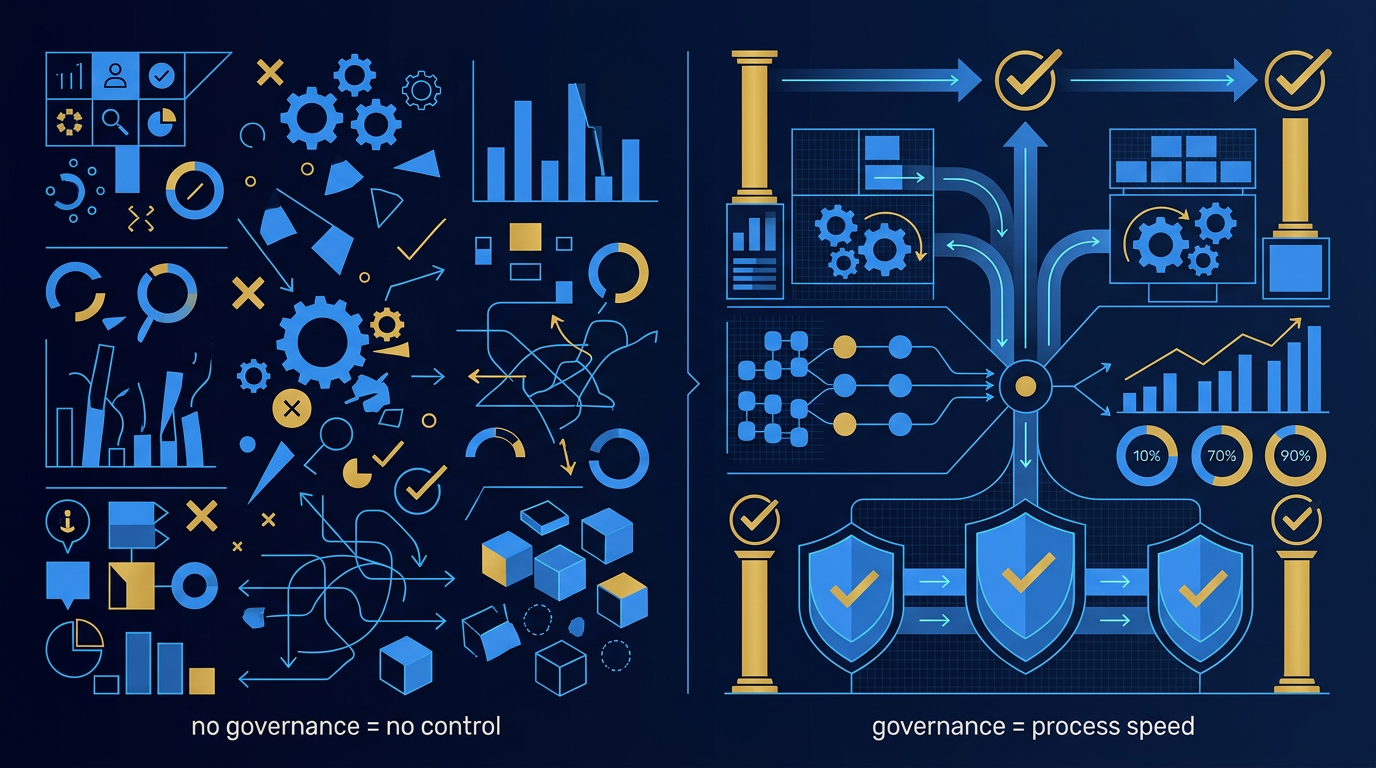

The prevailing narrative in boardrooms casts AI governance as a tax on speed, a compliance layer bolted onto innovation that slows pilots, frustrates vendors, and delays value capture. That framing is backwards. Organizations that have invested in durable governance infrastructure, including intake workflows, model inventories, impact assessments, and vendor due diligence protocols, are deploying AI tools faster than their less-prepared competitors, not slower. The upfront cost is real, but so is the compounding return: every subsequent deployment reuses the same scaffolding, the same legal review patterns, and the same technical validation playbooks. Governance, built correctly, is the engine of responsible velocity.
The Hidden Cost of Ungoverned Speed
Consider what happens when a talent acquisition team procures an AI-enabled assessment tool without a governance framework. Legal has to start from scratch on contract terms. Security runs an ad hoc data privacy impact assessment. Someone eventually asks whether the tool triggers New York City Local Law 144's bias audit requirement, or whether Illinois's AI Video Interview Act and the newer Illinois AIPA apply, or how Colorado SB 21-169 bears on any insurance-adjacent use case. Each of these questions is answered in isolation, often by the wrong person, and frequently after the contract is already signed. The result is rework, shelfware, and regulatory exposure the business did not know it was accepting.
Now contrast that with a governed environment. An intake form routes the tool to a standing AI review committee. A pre-approved impact assessment template identifies the jurisdictions in play, the protected classes involved, and the disparate impact testing cadence required under the Uniform Guidelines on Employee Selection Procedures. Vendor documentation requests are standardized, aligned with NIST AI RMF functions and, where applicable, the EU AI Act's high-risk system obligations for employment tools. What took six months of cross-functional improvisation now takes six weeks of structured review. The governance did not slow the deployment; it eliminated the avoidable friction.
Five Pillars That Compound Over Time
A defensible governance model rests on five interlocking capabilities: transparency and accountability, bias and non-discrimination testing, data privacy and security controls, explainability standards, and an audit and compliance framework. Each pillar, built once, serves every future AI deployment. A bias testing protocol designed for a resume screener applies with minor adaptation to a sourcing tool, a chatbot, or a skills inference engine. A vendor questionnaire aligned to EEOC guidance on algorithmic assessments under Title VII, the ADA, and the ADEA becomes reusable intellectual property. The marginal cost of governing the tenth AI tool is a fraction of the cost of governing the first, and the institutional knowledge accumulates rather than dissipates.
Governance as Competitive Positioning
There is also a market signal embedded in mature governance. Procurement teams at Fortune 500 buyers increasingly require vendors to produce bias audit summaries, model cards, and data lineage documentation before contracts advance. Organizations with governance infrastructure can respond in days; organizations without it either fabricate artifacts under pressure or lose the deal. The same dynamic plays out with regulators. When the EEOC, a state attorney general, or a works council asks how a hiring algorithm was validated, the company with a contemporaneous record of impact assessments, adverse impact testing, and human oversight checkpoints answers confidently. The company without that record enters a posture of reconstruction, and reconstruction under legal scrutiny is expensive, slow, and rarely complete.
The strategic question is not whether to build governance but when. Organizations that wait until a complaint, an audit, or a headline forces their hand pay the full cost of retroactive cleanup: litigation holds, vendor replacement, internal investigations, and the opportunity cost of every AI initiative that freezes during remediation. Organizations that build governance before they need it absorb a one-time investment and convert it into a durable operating advantage. Don't trust, validate is not a constraint on adoption. It is the discipline that makes responsible adoption sustainable at enterprise scale, and the sooner the scaffolding exists, the faster the business can move across every AI decision that follows.